

How Digital Data Makes the Relocation of 55,000 Objects Possible
How do you move over 55,000 historical objects without losing track of them? This massive logistical challenge is already keeping the team at the Museum of Franconia busy.
Away from the crowds of visitors and behind the scenes, preparations for the move of the storage facilities are underway, even though it will still be years before it takes place. By 2032, the entire museum, including its storage facilities, is scheduled to move into the renovated main castle of the Marienberg Fortress. Only about 4,000 of the museum’s total 55,000 objects are currently on display in the permanent exhibition for visitors. The rest are stored in the depots. One of these is housed in the former Fürstenbaumuseum, where 15,000 of the 55,000 objects are stored. The renovation of this area of the fortress is still pending. The new, long-term storage facility has not yet been built. Nor is the interim solution ready for the objects, some of which are highly sensitive. Nevertheless, one could argue that preparations for their transport began over 17 years ago. In 2009, the museum acquired the precursor to its current digital object database. This database will play a key role in the upcoming move.
Scans Provide Key Information from the Object Database
The collection’s diversity ranges from paintings to furniture and sculptures to historical everyday objects. The information on the individual collection items is stored in the database and linked together. For the move, each object must be uniquely identifiable, professionally packed, and able to be transported safely. Thanks to scanners and QR codes, at least the identification of objects via the object database runs smoothly. “Otherwise, it would slow things down incredibly and would also put a strain on the object,” says Saskia Rupp. Rupp and Quirin Eimer, who are responsible for inventory and collection management at the museum, respectively, can immediately access the most important information—including images, descriptions, age, weight, and owner—thanks to the QR codes. “The QR code is the link between the physical and digital worlds,” explains Quirin Eimer.
Digital Location Management Prevents Loss
One of Eimer’s and Rupp’s most important tasks at the moment is the digital cataloging and barcoding of the collection objects—that is, the technology that represents data as optically readable lines, bars, or patterns. The objects’ locations are also recorded—again via their own QR codes. “Without barcoding, it would be a never-ending search,” says Eimer. Every change in location must be documented and traceable.
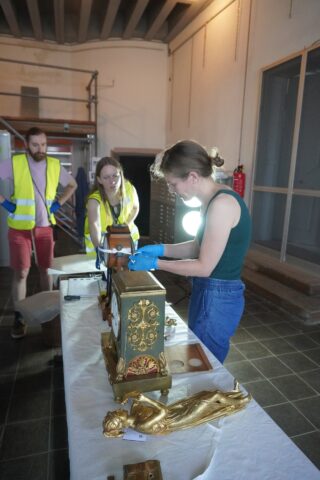
However, before an object can be moved from its location, its condition is checked and documented. The conservators then decide, based on the material, size, and fragility, what packaging and transport conditions are required. A painting requires different protective measures than a clock, and a piece of furniture requires different measures than a glass object. Particularly fragile pieces must be secured additionally and moved with the utmost care. “It’s a science in itself,” says restorer Susanne Wortmann, who is overseeing the relocation of the objects.
Additional Security Measures Due to Construction Work
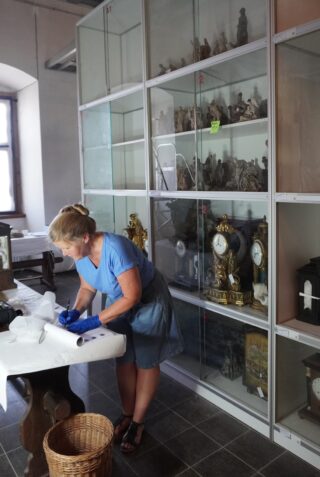
The ongoing construction work at the fortress poses additional challenges for the museum. To protect the approximately 15,000 items in storage at the former Fürstenbaumuseum from potential vibrations, further steps are currently necessary: Over a hundred clocks in the storage facility are being stored and secured by the conservators to protect them from vibrations. More than 500 paintings are being rehung and fitted with temporary shock absorption. Hundreds of glass and porcelain objects are being repackaged.
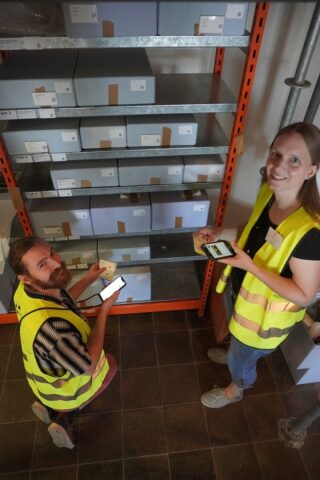
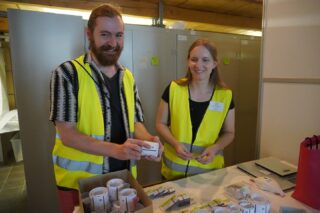
Always on hand: Quirin Eimer and Saskia Rupp. Using scanners and barcodes, they ensure that an increasingly accurate digital map of the storage facility is created. Every step of the process is digitally documented and remains traceable. This is important not only for the current move. “For provenance research—the history of an object’s origins—it’s important to know where an object was stored,” explains Eimer.
The QR code is small. Its significance for the future of the collection, however, is immense. As the renovation of the inner castle progresses and the actual relocation of the storage facility begins, it will already be precisely documented where each object is located, what condition it is in, and which route it is to take.
Thus, the question “How do you move 55,000 objects?” becomes a complex interplay of restoration, inventorying, collection management, and digital documentation.