

Extensive restoration is planned
Why the Banner of St Kilian Isn’t on Display at the Museum of Franconia on Kilian’s Day
While all of Würzburg celebrates Kilian, the patron saint of Franconia and the city’s patron saint, the actual star of the show remains hidden.
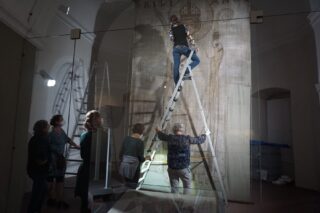
The famous Kilian Banner at the Museum für Franken is out of sight for visitors. But there’s a good reason for this: “Some treasures have to disappear from view for a while so that they can be preserved for many generations to come,” says museum director Dr. Richard Loibl.
The banner, dating from the second half of the 13th century, is one of the most important and valuable objects in the museum; with an area of about five by three meters, it is also one of the largest. The banner, on loan from the Frreunde Mainfränkischer Kunst und Geschichte, is not only considered the oldest surviving military flags in Germany but also one of the oldest depictions of St. Kilian in existence.
Why isn’t the banner currently on display at the museum?
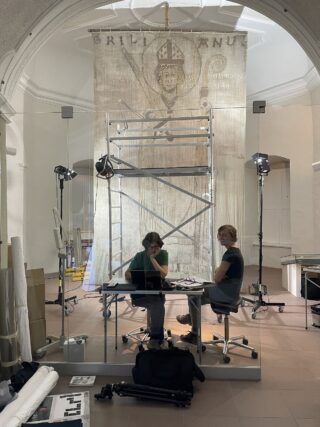
When the Museum of Franconia reopens in 2032 in the inner castle of the Marienberg Fortress, the banner will take its place at the heart of the permanent exhibition. But there is still a long way to go. Veronika Genslein, deputy director of the Museum für Franken, says: “The St. Kilian Banner is still housed in the premises of the former Fürstenbaumuseum. You can’t just move a 700-year-old banner.” Simply removing the banner as gently as possible and storing it properly until it is displayed again poses a major conservation challenge.
A High-Tech Display Case as Its New Home
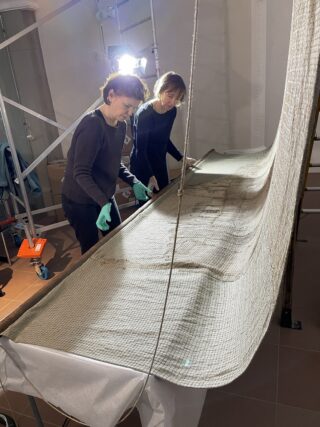
Katharina Mackert and Laurence Becker are experts in textile restoration. Together with the conservators at the Museum of Franconia, Susanne Wortmann and Brigitte Brühl, they have developed a conservation plan. A high-tech display case—climate-controlled, motorized, and free of all harmful substances—will house the banner in its entirety in the future. To protect the material, the banner will be displayed lying flat rather than hanging. “Otherwise, the ancient fabric could be damaged by its own weight,” explains Dr. Loibl. Instead of natural light, only LED lamps will provide illumination in the planned St. Kilian’s Banner room at the new Museum of Franconia.
Steps Toward Restoration
Before restoration of the ancient banner can begin in close coordination with the lenders, an investigation was conducted to determine what the banner might have originally looked like and which areas had been altered or repaired over the course of its approximately seven-hundred-year history. Fabric samples were taken and analyzed. The banner is made of linen, to which appliqués of colored silk and leather were presumably attached. The contours of the face and hands, painted with tempera, were examined using infrared radiation. A C14 analysis also provided clues to the age of the linen fabric, which dates back to around the year 1266.
St. Kilian’s banner is a symbol of Franconian identity
The radiocarbon method (C14 method) can be used to date carbon-containing materials—particularly organic ones—that are between 300 and 600,000 years old. For a fabric approximately seven hundred years old, the margin of error is plus or minus 20 to 50 years. On the reverse side of the banner is a Latin inscription: “In the year of our Lord 1266, a battle took place on the feast day of Saint Cyriacus.” It is quite possible that the banner was actually carried by troops of the Würzburg Cathedral Chapter, who fought victoriously against the army of the County of Henneberg in a conflict over the succession to the bishopric. The inscription would then have been added after the battle. However, it cannot be ruled out that the entire banner was made specifically as a memento of the victory.
The triumph in the Battle of Saint Cyriacus became a symbol of the city of Würzburg’s close connection to Saint Kilian as its patron saint. When it was not being carried through the city for religious processions, the banner likely hung in the cathedral for centuries. With the reopening of the Museum of Franconia in 2032, not only will an important exhibit return to public view, but also a central symbol of Franconian history and identity. “In a truly unique way, Franconia and Würzburg are interwoven in the St. Kilian Banner. This fits perfectly with our museum’s motto: ‘Looking out from Würzburg onto Franconia,’” emphasizes Dr. Loibl.