




Franconia around 1920
An exhibition of the Frankenbund
August 7, 2021 - October 10, 2021

Life in Franconia around 1920 was shaped by the First World War and its consequences. Contrasts determined political life as well as the actions and thoughts of every citizen. Art and culture make this inner and outer conflict visible.
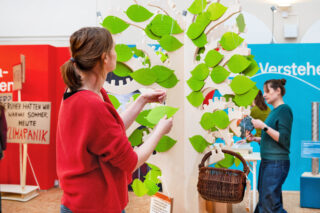
On October 11, 1920, the Frankenbund was founded in Würzburg at a time of uncertainty and a longing for normality. On the occasion of the 100th anniversary and in order to understand this founding process, the Franconian Federation is showing a traveling exhibition in six stations. Highlights from cultural life depict the time one hundred years ago in relation to the political and social situation. Scenic representations, illustrations and texts from the fields of theater, poetry, literature, music, fine arts, architecture and clothing provide a brief insight into everyday life in Franconia.
Room modules visualize the authentic life situation of the Franconian population around 1920, primarily with re-enacted events, performances, models from literature, newspaper articles and archival documents. Most cultural performances took place in the larger Franconian cities such as Nuremberg, Würzburg, Bamberg etc. and often spread slowly from there to the small towns and rural areas.
For example, the "Theater and Politics" station contrasts the scandalous performance of Ernst Toller's play "Masse Mensch" in the Nuremberg Municipal Theatre with the bloody suppression of the Kapp Putsch at Nuremberg Central Station in two scenes.
Another module on the subject of the "art scene" focuses on the nationally important art exhibition in the Schrannensäle in Würzburg, but also on the often religiously influenced forms of expression of artists traumatized by the horrors of the First World War, as can be seen in the memorial painting by the painter Anton Rausch in Fladungen. In addition, a picture puzzle contrasts the traditional with the "modern" style of representation.
The theme of "Clothing" is presented in a small fashion show in the recreated Nuremberg Künstlerhaus on a turntable with reform clothing from the Nuremberg workshop of the Association of German Women's Clothing and Women's Culture and fashion around 1920. The dresses are all made of paper in accordance with an announcement by the Wild department store in the Weissenburger Tagblatt that the new models could be viewed in its shop window in paper replicas.
Other topics in the exhibition will include the housing and supply shortage, commercial music as well as the Tonkünstlerfest and cultural life through to escapism. Finally, the founding of the Frankenbund in the "Franziskaner" in Würzburg and its very rapid spread in Franconia are presented in a room module.
The exhibition, which does not aim to be exhaustive in any area, provides a small, selected insight into the cultural life that took place despite hardship and deprivation.
